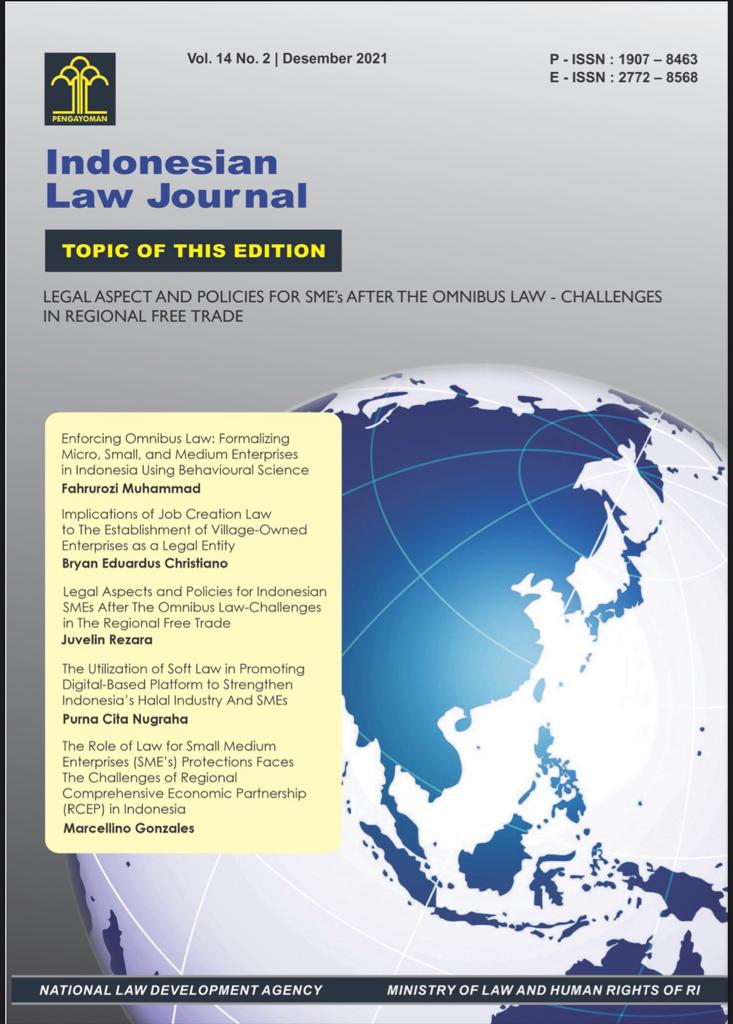
ENFORCING OMNIBUS LAW: FORMALIZING MICRO, SMALL, AND MEDIUM ENTERPRISES IN INDONESIA USING BEHAVIOURAL SCIENCE
DOI:
https://doi.org/10.33331/ilj.v14i2.70Kata Kunci:
MSMEs, Formalization, Behavioural ScienceAbstrak
Micro, small, and medium enterprises (MSMEs) play a significant role in creating approximately 90% of businesses worldwide. Indonesia has also been dependent on the MSMEs. However, MSMEs have been dealing with obstacles to maintain their sustainability. Their lack of formality results in their inability to keep their business, obtain funding, and low productivity. The government responds to this problem by enacting Law No. 11 of 2020 on Job Creation. This paper examines the importance of MSMEs' formalization, which is limited to registering their business or securing their entity in this case. This paper uses the normative juridical method, which shows that the government needs to use behavioural science as a new approach to implementing the Job Creation Law successfully by using nudge, which is a strategy to boost formalization that relies on simplifying procedures, delivering information that focuses on promoting the benefit, and utilizing social influence to encourage people to formalize.
Referensi